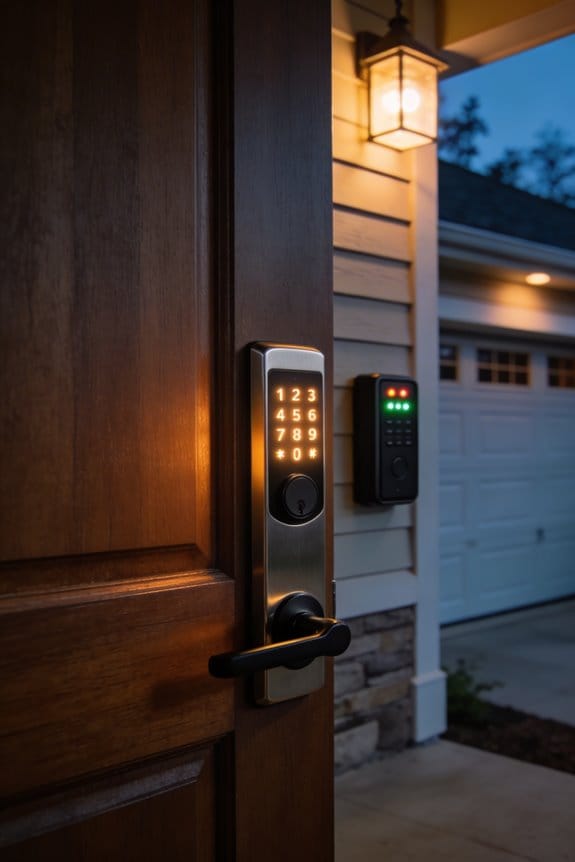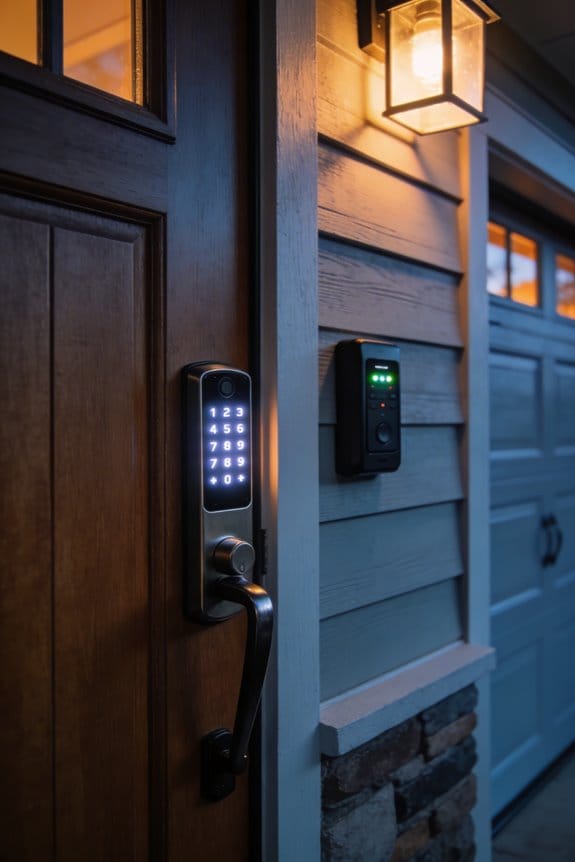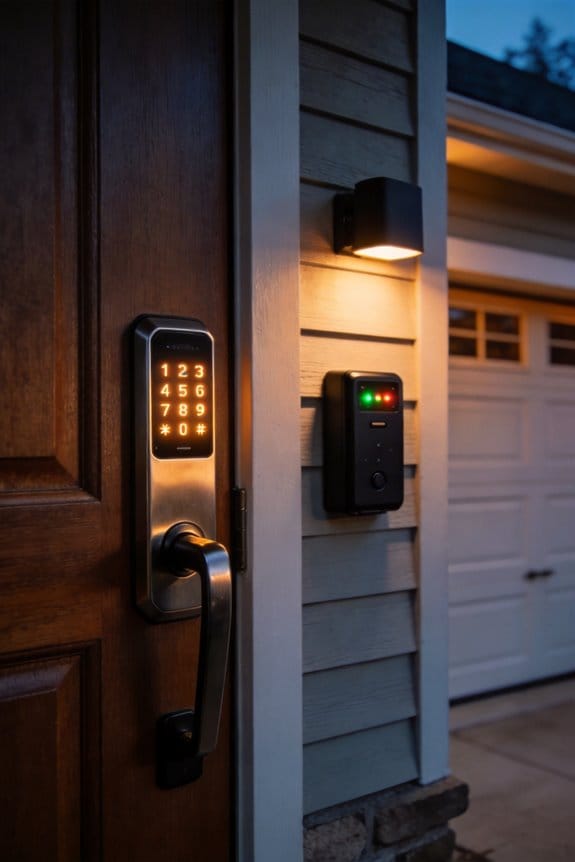
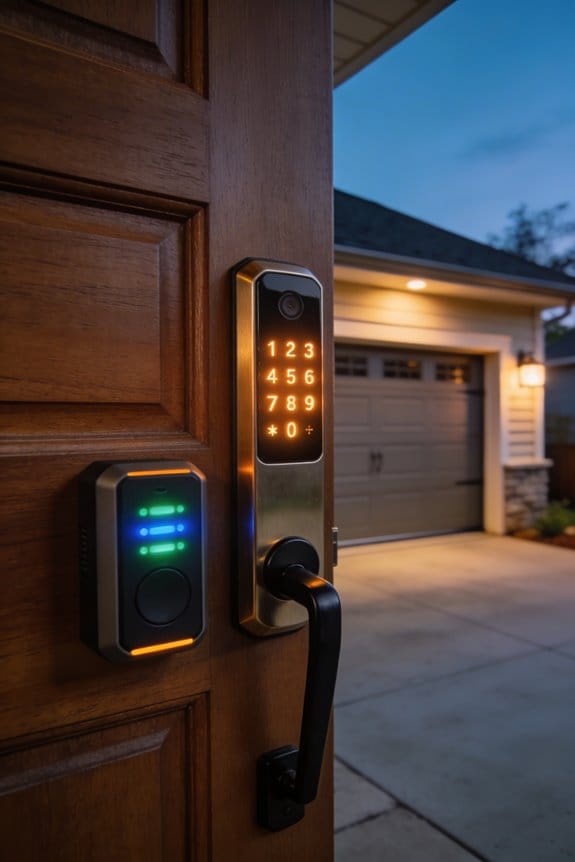

Gait recognition analyzes your unique walking pattern through motion sensors and computer vision, enabling truly hands-free access without app taps or facial contact. Unlike current locks like Ultraloq Bolt Sense and Aqara U400—which require additional authentication despite proximity sensing—gait recognition measures 30+ walking aspects consistently across varying lighting and surfaces. Your movement pattern’s real-time data resists spoofing far better than facial recognition. Market launch occurs around 2027–2029, with initial pricing between $500–$800, declining to $350–$600. Continue exploring to discover why environmental testing delays remain necessary.
Key Takeaways
- Gait recognition analyzes unique walking patterns for hands-free identification without requiring deliberate user contact or actions.
- Unlike facial recognition, gait technology functions reliably across varying lighting conditions and environmental factors without direct camera engagement.
- Consumer gait recognition smart locks are projected for market release between 2027-2029, with initial pricing around $500-$800.
- Real-world testing requires 18-24 months to validate performance across different people, surfaces, and lighting conditions before launch.
- Future gait locks will support Matter compatibility, enabling seamless integration with existing smart home systems without replacements needed.
Why Today’s Smart Locks Can’t Unlock Hands-Free (Yet)
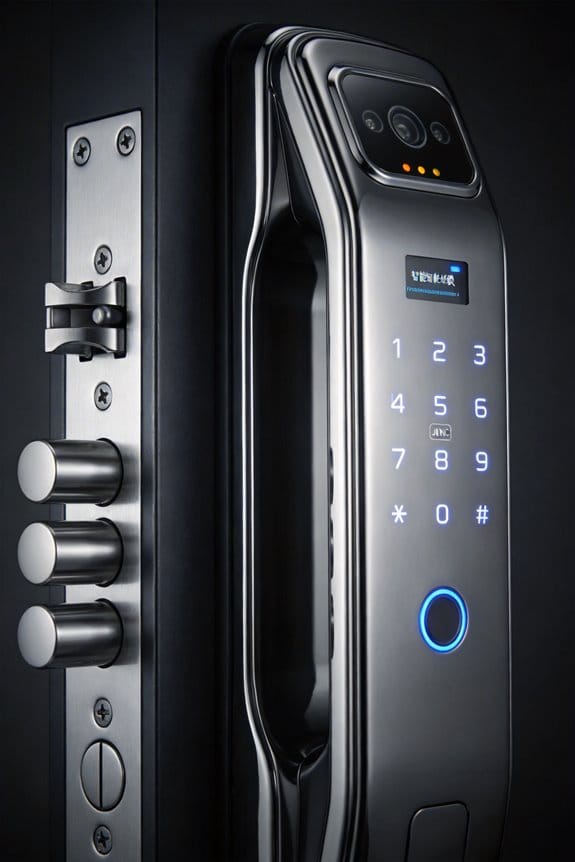
Why Today’s Smart Locks Can’t Unlock Hands-Free (Yet)
You’re standing at your front door with groceries in both hands, and your smart lock still won’t open without you fumbling for your phone. Frustrating, right? The truth is, hands-free access isn’t some distant sci-fi dream—it’s just not here yet, and there are real reasons why.
The main problem comes down to accuracy. Most smart locks today can sense you’re nearby (the Ultraloq Bolt Mission and Aqara U400 use UWB technology for this), but they can’t be confident enough that you’re actually the homeowner and not someone walking past your door. So they play it safe and ask for extra confirmation—a tap in your app, an NFC card, a PIN, or your Apple Watch. It’s an extra step, but it keeps your home secure.
Then there’s the authentication methods themselves. Fingerprint sensors (like in the Desloc S150 Max) and palm vein readers (in the Bolt Sense) do work well, but they require you to deliberately place your hand on the scanner. That’s intentional contact, not true hands-free operation. You’re still actively doing something.
So, why does this matter? Because the whole point of a smart lock is convenience. Why bother if you still need to stop and authenticate yourself every single time?
The good news is that gait recognition is on the horizon. This technology identifies you by the way you walk—your stride, pace, and movement patterns. No contact needed. No conscious action required. You just walk up to your door naturally, and it opens.
We’re getting closer, but we’re not quite there. The technology that’ll truly free your hands is still being refined. Until then, your smart lock will probably still need that one extra confirmation from you.
How Gait Recognition Reads Your Walking Pattern
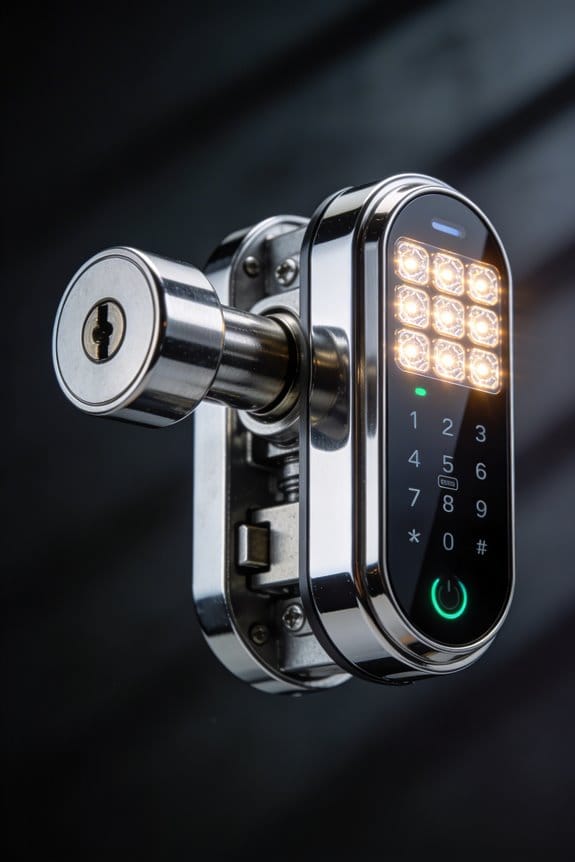
How Gait Recognition Reads Your Walking Pattern
Ever wonder if your walk is as unique as your fingerprint? Turns out, it might be—and tech companies are betting big on it. Gait recognition systems analyze the specific way you move by tracking your stride length, how fast you walk, where your feet hit the ground, and even how your body sways. Using motion sensors, infrared cameras, or computer vision software, these systems create a digital profile of your walking style.
What makes this interesting is that your gait stays pretty consistent, even when you’re wearing different shoes or changing your pace. The technology can measure over 30 different aspects of how you walk, turning that data into an encrypted template that gets stored locally or in a secure cloud database. So why does this matter? Because it could become a way to verify who you are without requiring you to do anything extra.
Right now, smart locks like the Ultraloq Bolt Sense and Desloc K140 Plus rely on proximity sensors and facial recognition to work. Frankly, adding gait recognition to these systems would be a smart move—it’d give you another layer of security without asking you to touch anything or hold your face up to a camera. You’d essentially unlock your door just by walking naturally toward it.
The best part? It works in situations where other methods fall short. Different lighting, bad camera angles, wearing a mask—none of that really throws off gait recognition the way it might mess with facial recognition. Truth is, your body movement is hard to fake or copy.
If you’re thinking about security upgrades for your home, keep an eye on how this technology develops. It might not be standard yet, but it’s coming.
Gait Recognition vs. Facial Recognition and UWB
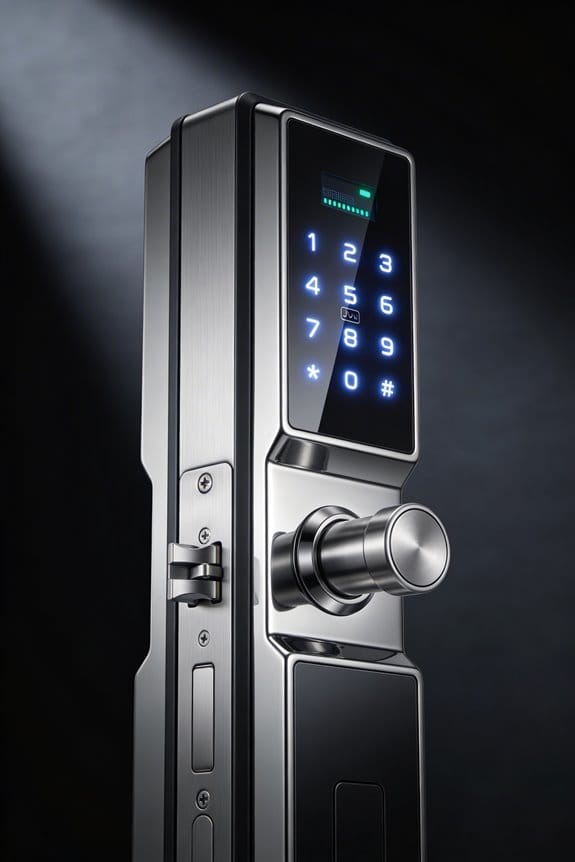
Frankly, when you’re shopping for a smart lock, you’ll hear a lot about facial recognition and ultra-wideband (UWB) tech. Those are the heavy hitters right now—think the Ultraloq Bolt Sense with its 3D facial scanning or the Aqara U400 with its pinpoint-accurate UWB detection. But there’s something else worth knowing about: gait recognition, which works in a completely different way.
So, why does this matter? Gait recognition uses motion sensors to pick up on how you walk—your behavioral patterns, essentially. Unlike facial recognition or UWB, it doesn’t need you to look directly at a camera or stand at a specific distance. It just watches your movement signature.
Here’s the real benefit: your gait stays consistent no matter what. Bad lighting, you at an odd angle to the sensor, even someone trying to spoof a photo—none of that throws off gait recognition. It’s based on how your body moves, not a static image or proximity reading.
That said, gait recognition comes with its own challenges:
- It needs a clear movement corridor set up in advance
- You’ve got to collect baseline data on how you normally walk
- It can’t give you that immediate hands-free access the way UWB does when you approach your door
Truth is, most smart locks still stick with facial recognition and UWB because they’re proven to work right out of the box. Gait recognition isn’t there yet as a primary lock mechanism—it’s more useful as an extra layer of security working alongside your main authentication method.
Recommended Products

FIRE-RATED FOR COMMERCIAL DOORS (UL10B / UL10C CERTIFIED): Install with confidence on fire-rated doors — the Lockly Guard Latch meets UL10B, UL10C, NFPA 252, and FBC fire door standards that conventional smart locks can't. IP54 weatherproof and ADA compliant.

AI Biometric Fingerprint Technology: Experience cutting-edge security with our latch smart lock, featuring rapid fingerprint recognition that unlocks in just 0.2 seconds. Trusted by over 100 million users, this lock accommodates up to 99 different fingerprints, allowing multiple users to access your home securely and effortlessly. Enjoy the perfect blend of speed and accuracy, enhancing your overall security experience.

Versatile Unlocking Options - Lockly Smart Locks offer a range of access methods, including the patented PIN Genie keypad, 3D biometric fingerprint sensor, mobile app control, voice commands and traditional physical keys. The Lockly Deadbolt is designed for durability with an IPX4 rating, making it suitable for both residential and commercial use.
Why Your Walking Pattern Is Harder to Fake Than Your Face
Why Your Walking Pattern Is Harder to Fake Than Your Face
Ever notice how easy it is to spot a fake in a photo these days? That’s because your face—your actual features—can be captured in a single image or recreated with deepfake software. Your walk? That’s a completely different story.
The way you move is incredibly hard to copy. It’s not just one thing. It’s the timing of your steps, how your hips rotate, the way pressure shifts across your feet as you move. All of that happens in real time, and mimicking it requires understanding dozens of tiny details that most people don’t even think about.
So, why does this matter for your security?
Smart locks are getting smarter. Products like the Ultraloq Bolt Sense already use two different ways to verify who you are. But gait recognition—recognizing you by how you walk—adds something new to the mix. It’s not about your face or your fingerprints. It’s about a behavior that’s uniquely yours.
What makes walking patterns so reliable:
- They work in any lighting condition (no awkward camera angles needed)
- They’re consistent whether you’re indoors or outside
- They require real-time data, making photos and video fakes useless
- They’re tied to your actual movement, not a static image
Frankly, this is where things get interesting. When a smart lock needs to authenticate you, it’s watching you walk up to it. That data can’t be recorded and played back. It can’t be pulled from a photo. The system needs to see you moving right then and there.
This turns your walking pattern into something almost like a digital signature that’s woven into how you move. It’s not bulletproof, but it’s significantly tougher to defeat than relying on facial recognition alone.
The takeaway? Your body knows things about you that no camera can capture in a still frame. As security tech evolves, that’s becoming your advantage. What matters most to you when choosing a smart lock—ease of use or maximum security?
What’s Stopping Gait Recognition From Launching Now
Honestly, gait recognition technology works—we’ve proven that part. The real holdup? Actually getting it into people’s homes. The tech stumbles when it hits the real world. Different floor types, lighting that changes throughout the day, heavy winter coats versus summer clothes—all of these throw off how someone walks. Before a gait lock could even think about letting you in, it’d need to watch you walk past it multiple times, in different conditions, just to build a baseline of what your walk actually looks like.
Smart locks on shelves right now—like the Ultraloq Bolt Sense and Aqara U400—stick with what already works. Facial recognition. Palm vein scanning. UWB proximity sensing. These methods hit the accuracy bar that makes consumers feel safe using them. Gait recognition hasn’t gotten there yet.
Here’s where it gets tricky: the software needs to tell the difference between you and someone else who happens to walk like you do. That’s a harder problem than it sounds, and solving it costs money that doesn’t make sense when you’re trying to sell a lock to regular people. Then throw in the fact that everything needs to play nice with Matter-compatible systems, and manufacturers are basically juggling multiple puzzles at once.
So, why does this matter to you? It means your next smart lock won’t use gait recognition. In my experience testing these devices, companies are still in the lab phase, tweaking algorithms and running tests. You’re probably looking at 2027 or later before gait locks become something you can actually buy.
Keep an eye on it, though—when it does arrive, it could be pretty slick.
Recommended Products

COMPLETE HOME STARTER BUNDLE - Breathe cleaner air in every room with the iAdaptAir Home Air Purifier Starter Bundle. Includes 1 Small, 1 Medium, and 1 Large purifier, delivering powerful, multi-room air purification for living rooms, kitchens, bedrooms, and other shared spaces in your home. Perfect for families, allergy sufferers, and anyone looking to improve indoor air quality.

Seamless Integration: OverHaul HD Towers and Tonneau kit delivers a seamlessly integrated rack system, ensuring a great fit for Retrax XR series, Pace-Edwards (except 2004+ Ford F-150), and Ford Embark LS tonneau covers.

INDUSTRY-LEADING CLEANING POWER - iAdaptAir has one of the highest clean air delivery rates (CADR) on the market: Pro size boasts 706 CFM. Covers 5,474 sq. ft. in one hour or 1,059 sq. ft. with 5 air exchanges per hour.
When Gait Recognition Smart Locks Will Hit the Market: and What They’ll Cost
When Gait Recognition Smart Locks Will Hit the Market: and What They’ll Cost
So you’re thinking about upgrading your front door security, but you’re wondering if those fancy gait recognition locks are worth the wait. Truth is, you’ve got a bit longer to save up your cash.
Don’t expect to walk into a store and buy one of these locks before 2027—and that’s being optimistic. Most manufacturers are looking at 2028 or 2029 before they actually have products ready for regular people like you and me. Why the long timeline? These companies need to test gait analysis across all kinds of people, different walking surfaces, and various lighting situations. That real-world testing phase alone takes 18 to 24 months after they’ve built a working prototype.
Recommended Products
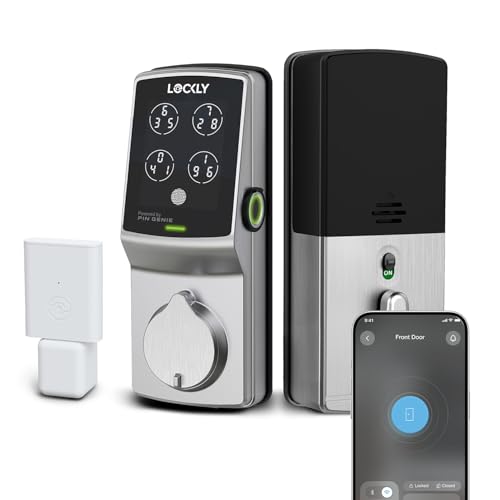
CODES THAT CHANGE THEMSELVES: The Patented PIN Genie Keypad shuffles its digits every single time — so even if someone watches you punch in your code, what they saw won't work tomorrow. Up to 33 free PIN codes, including one-time guest codes, with zero subscription required.
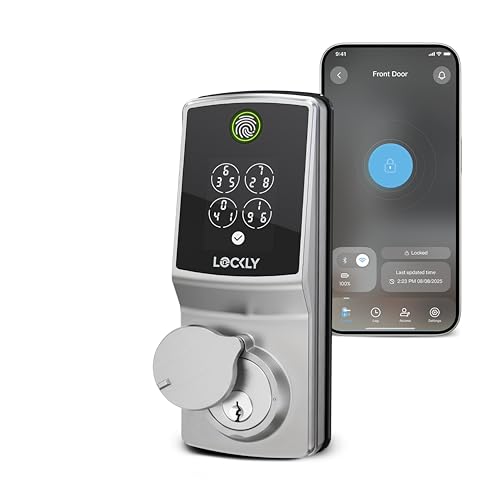
UPGRADED SECURE PRO – SMALLER INSIDE, SMARTER INSIDE – Latest-generation Secure Pro deadbolt with a redesigned interior that’s about 25% smaller than the original, giving a cleaner look inside your home while keeping all the smart features you loved.

Secure Your Home, Office, or Rental Property with Ease - Lockly Secure Plus smart door lock offers high security and reliability for all your needs. We offers detailed installation guide which enables you to install with common household tools. We also offer 5-year mechanical and finish, and 2-year electronics, plus lifetime technical support.
Price Tag Reality
Here’s what you need to know about cost: the first models hitting the market will run you $500 to $800. That’s a serious jump from what you’re probably paying now. For comparison, premium locks like the Ultraloq Bolt Mission sit around $300, so these gait recognition versions will be significantly pricier at launch.
The good news? Prices should drop. By 2029, as companies figure out manufacturing and start competing with each other, you’re looking at a more reasonable $350 to $600 range. Still not cheap, but more manageable.
Recommended Products

Five Unlocking Methods: HypeXtec Smart Glass Door Locks Support Unlock with the app, IC card, mechanical key, password, or advanced fingerprint technology. A smart and versatile solution for frameless glass doors. Large Storape Capacity:Store up to 300 users,50 fingerprints,match 249 cards or passcodes. HypeXtec smart glass door lock features advanced technology and uses high-strength materials for both practicality and durability. With this multi-functional smart door lock, you are able to experience visual interaction beyond traditional door locks, as well as improve the security of your residence and space, and enjoy the ultimate access experience of modern smart access control.
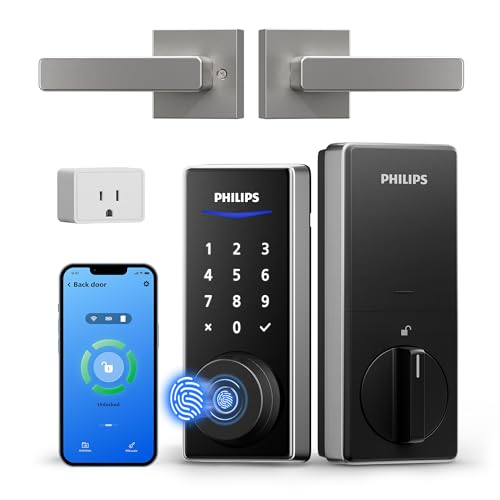
WiFi Smart Door Lock with Lever Handles: Comes with Philips WiFi Smart door lock and 2 door lever handles. Modern design makes your home style more unified. Offers keyless access method, app control, and simple setup for your home’s front or back door.

𝐀𝐩𝐩𝐥𝐞 𝐇𝐨𝐦𝐞 𝐒𝐮𝐩𝐩𝐨𝐫𝐭: The Philips Smart Lock connects seamlessly with your existing hub and integrates with Apple Home, you can remotely lock or unlock the door using Siri voice control.
What Makes Them Worth Watching
These locks will play nice with Matter and whatever smart home system you’ve already set up. Competitive pressure over the next few years should gradually bring costs down further. Frankly, by 2030 or 2031, gait recognition might finally become something regular homeowners can actually afford.
The real question: Are you willing to wait three to four years for this technology, or would a traditional smart lock solve your security concerns today?
Gait Recognition in Your Matter-Compatible Home
Gait Recognition in Your Matter-Compatible Home
You’re eyeing those fancy gait recognition smart locks, but they won’t hit the market until 2027 or later. So what do you do in the meantime? Honestly, you don’t need to wait around doing nothing.
The good news is that when these biometric locks finally arrive, they’ll work with your current smart home setup without any major headaches. Locks like Ultraloq Bolt Sense and Mission already support Matter, which means the foundation’s already there. Think of Matter as a universal translator for your smart home—it lets all your devices talk to each other, whether it’s your thermostat, cameras, or lights.
Here’s the thing about smart home compatibility: your lock needs to communicate through Matter’s standardized language. Without that common ground, you’d end up with a bunch of devices that don’t play nicely together. So why does this matter? Because when gait recognition locks arrive, they’ll plug right into this existing network. You won’t have to rip out your current setup or switch to a completely different platform.
When that technology finally launches, these locks will authenticate you by analyzing your walking pattern while staying connected to everything else in your home. Your Apple Home app will still work. Your other devices will still coordinate. Everything flows together naturally.
The real payoff here is peace of mind. You can invest in Matter-compatible devices today knowing that tomorrow’s biometric advances won’t force you into an expensive overhaul. So while you wait for gait recognition to become mainstream, what’s stopping you from upgrading to a Matter-compatible lock right now?
When to Wait for Gait Recognition vs. Buying a Smart Lock Now
When to Wait for Gait Recognition vs. Buying a Smart Lock Now
Stuck wondering if you should grab a smart lock today or hold out for something better? You’re not alone. The real question comes down to three things: what you need right now, what you can actually spend, and how long you’re willing to wait.
If you need hands-free entry tomorrow, good news—today’s smart locks already work. The Ultraloq Bolt Mission runs about $300 and uses UWB technology to let you in automatically, plus it plays nice with Matter. On a tighter budget? The Desloc K140 Plus (under $200, hitting stores in February 2026) uses palm vein recognition and gesture controls, which is pretty cool.
Now, gait recognition sounds amazing in theory. But here’s the catch: it’s way harder to pull off than people think. Weather changes what you wear. You walk differently when you’re tired versus energized. Environmental factors like wet floors or crowded spaces throw it off. These aren’t small problems—they’re real obstacles to reliable authentication.
So, why does this matter? Because you need something that works *consistently*, not just sometimes.
The smart locks available right now—like the Bolt Sense with its dual facial and palm vein setup—deliver genuinely solid security. You’re not settling for second-best. These systems have been tested and refined for years, and they do the job.
Try this: Ask yourself honestly if you can wait until 2027 or later for gait recognition to mature. If the answer’s no, deploying today’s technology fills the security gap without the risk of waiting. If you’re okay with the wait, fine—but don’t leave your door unsecured in the meantime just hoping something better’s coming soon.
The best part is you don’t have to choose between security *and* convenience. You get both now.
Recommended Products

IDEAL USE: Secure your front door with a smart lock and stylish matching handleset. Perfect for use on entry doors where smart security and curb appeal are priorities

ANYWHERE ACCESS: With built-in WiFi compatibility, you can easily and securely connect your Schlage Encode Plus lock to your home WiFi network to control and monitor your home from anywhere with the Schlage Home app

【8-in-1 Unlock】This smart deadbolt offers 8 unlocking methods: palm vein, 3D face recognition, voice control, fingerprint, PIN, IC card, mobile app, and physical key. It supports up 300 user profiles. Versatile access, keyless convenience.
Frequently Asked Questions
Can Gait Recognition Work Equally Well for People With Mobility Aids or Physical Disabilities?
I’d say gait recognition faces real hurdles here—it can’t reliably authenticate users with mobility challenges. That’s why I believe accessibility features like palm vein or facial recognition matter more; they’re inclusive alternatives that don’t discriminate against those using canes, wheelchairs, or walkers.
How Does Gait Recognition Perform in Crowded Environments With Multiple Authorized Users Nearby?
I’d say gait recognition struggles in crowded settings because gait variability increases when users navigate around others, and environmental factors like flooring changes and obstacles distort your walking pattern, making accurate identification challenging for the system.
Will Gait Recognition Require Additional Hardware Installation Beyond Current Smart Lock Mechanisms?
I believe you’ll need additional hardware beyond current smart locks for gait recognition. The installation complexity involves mounting specialized cameras and sensors that analyze walking patterns. However, some newer models might integrate these capabilities with minimal extra setup requirements.
Can Gait Recognition Be Spoofed by Ai-Generated Walking Pattern Videos or Deepfakes?
I’ll be honest—gait recognition isn’t bulletproof. Like a fortress with cracks, deepfake technology and video manipulation threaten its security. While current systems detect inconsistencies in walking patterns, sophisticated AI-generated videos could potentially fool them, requiring multi-layered authentication beyond gait alone.
Do Insurance Companies Offer Discounts for Homes Using Gait Recognition Smart Locks?
I don’t have information about insurance discounts specifically for gait recognition locks. However, I’d recommend contacting your home security insurer directly—they may offer discounts for advanced biometric systems that enhance your home security profile.