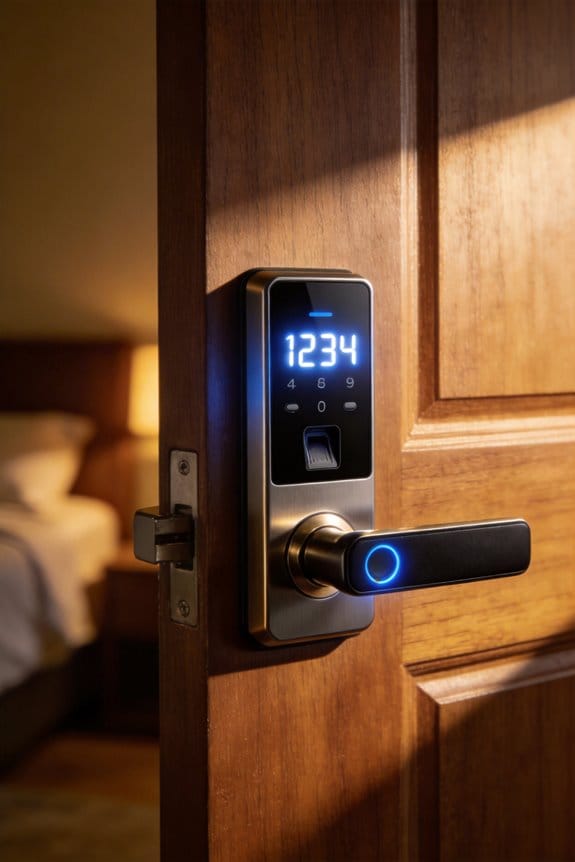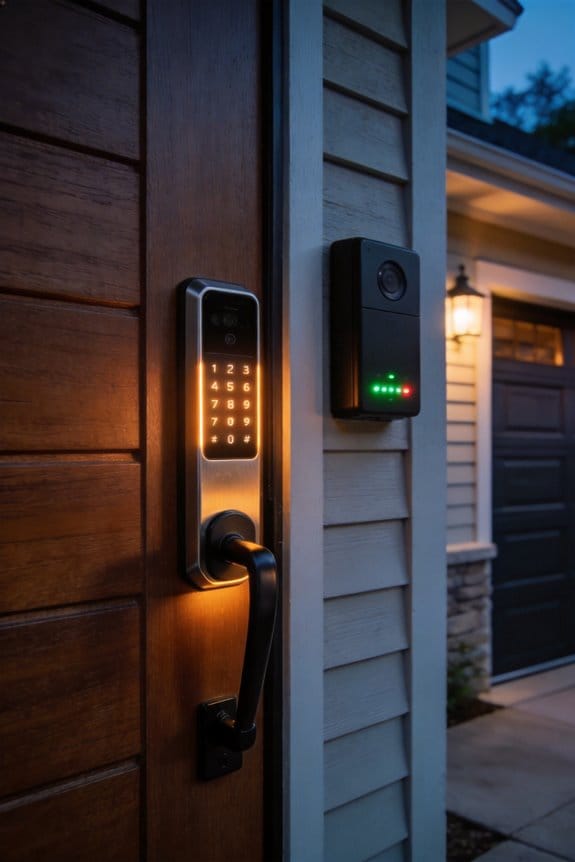
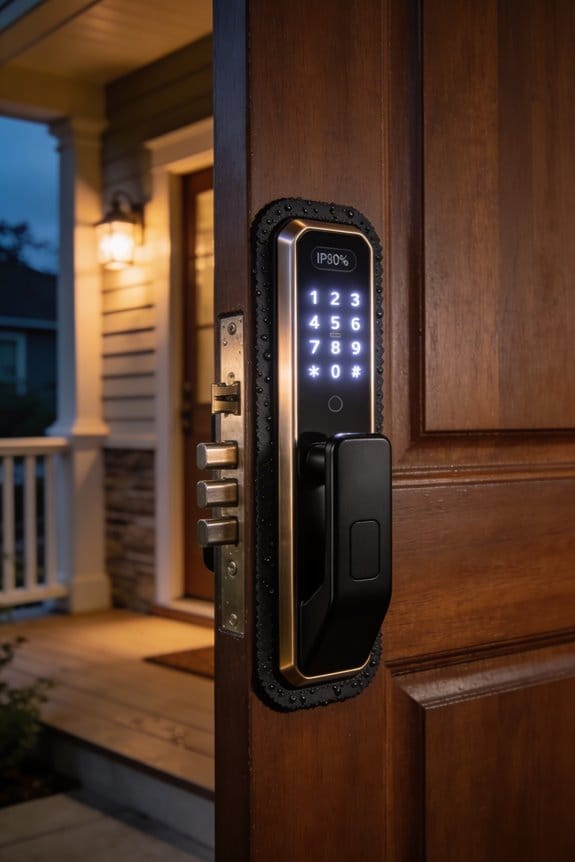

IP68 ratings guarantee complete dust protection and submersion beyond 1 meter, but the engineering involves silicone gaskets, epoxy coatings, and marine-grade stainless steel working together against water ingress. However, the IEC 60529 standard’s 30-minute fresh water test doesn’t predict real-world degradation from dynamic pressure, thermal cycling, and salt exposure—factors that can compromise seals within 3-10 years. Understanding these limitations helps you match your lock’s specifications to actual environmental conditions.
Key Takeaways
- IP68 ratings guarantee dust-proof construction and continuous water submersion beyond 1 meter depth, providing superior protection for exposed smart deadbolts.
- Multiple sealed layers using silicone gaskets, rubber O-rings, epoxy coatings, and marine-grade stainless steel create redundant barriers against water ingress.
- Static submersion testing doesn’t simulate real outdoor dynamic pressures, which can exploit microscopic seal imperfections and compromise long-term effectiveness.
- Seal degradation occurs within 3-5 years outdoors due to thermal cycling and UV exposure; high-quality silicone seals may last 7-10 years with maintenance.
- Saltwater and chlorinated environments accelerate material deterioration; marine-grade 316L stainless steel is essential for harsh coastal or pool-adjacent applications.
What IP68 Actually Means for Your Smart Deadbolt
When you’re shopping for a smart deadbolt, you’ve probably seen “IP68” plastered all over the specs. But what does it actually mean for your door?
That rating breaks down into two numbers. The first digit (6) means your lock is completely dust-proof—nothing’s getting in there. The second digit (8) is where water protection comes in: your lock can handle being submerged in water deeper than 1 meter. Honestly, that’s pretty solid protection for a device on your front door.
So, why does this matter? Because manufacturers have to actually *prove* their locks can handle this stuff. They run tests by dunking the deadbolt in fresh water for at least 30 minutes, typically at depths between 1.5 and 3 meters. To meet IP68, the lock needs sealed enclosures and tough materials that keep water away from all the electronic guts inside.
Here’s the thing though—real life isn’t a lab. Your smart lock sits outside facing rain, humidity, and temperature swings. Try this: always check your specific lock’s documentation for exact depth ratings. Saltwater, high-pressure jets from a hose, or heavy weather can behave differently than the controlled testing conditions.
The bottom line? IP68 is a solid baseline that means your lock can take moisture exposure without dying on you. But treat that rating as a guide, not a guarantee, and follow your manufacturer’s installation recommendations to keep your lock working for years.
What’s your biggest concern about smart locks and water exposure?
How Sealed Construction Provides IP68 Protection
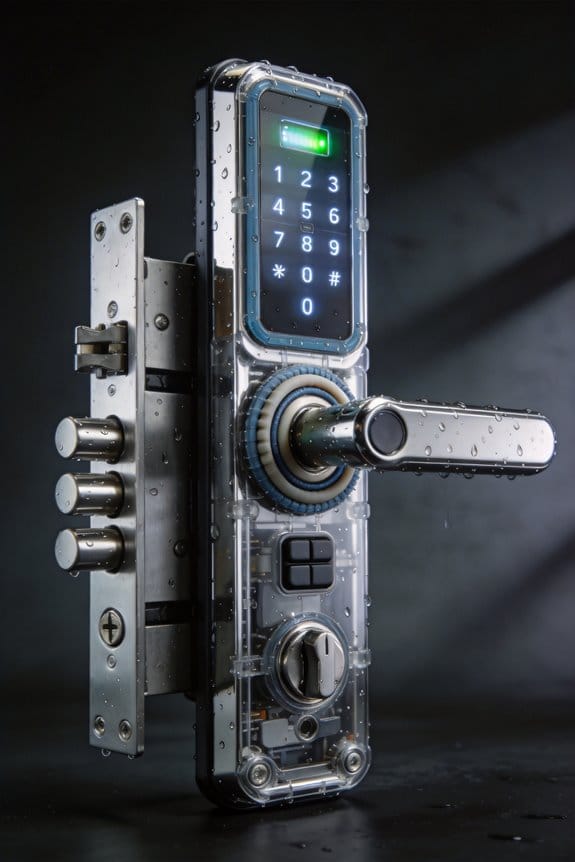
How Sealed Construction Provides IP68 Protection
You’ve probably wondered why some smart deadbolts survive years of rain and snow while others fail after one bad storm. The answer isn’t magic—it’s how they’re built from the inside out.
Manufacturers use several sealing methods to keep water out. Silicone gaskets, rubber O-rings, and epoxy coatings get placed around the electronics and battery compartment. Why does this matter? Because even one tiny gap lets water creep in and destroy the circuits. Material choices matter just as much as the sealing techniques themselves.
Here’s what separates a decent deadbolt from a reliable one:
- Marine-grade stainless steel for the outside housing
- Polycarbonate for internal seals
- Specialized elastomers that handle temperature swings and sun damage without cracking
These layers work together. Think of it like a fortress with multiple walls—if water gets past one barrier, another one stops it. So when you’re looking at IP68 specs, you’re really looking at redundant protection. That’s what lets deadbolts stay submersed without failing, which matters if your door sits exposed to heavy rain or coastal spray.
The best part is you don’t need to understand every technical detail. You just need to know that if a manufacturer cuts corners on sealing, you’ll find out the hard way—usually when water damage hits.
Does your deadbolt sit in a high-moisture area? That’s when sealed construction becomes your best investment.
Recommended Products
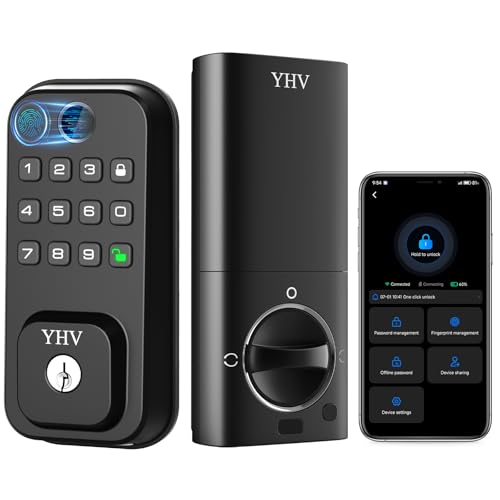
Multi-access Unlock: The YHV smart lock CA02 offers 6 unlocking options like biometric fingerprint recognition, App, password, key or voice control with Alexa/Google Voice Assistant, no need to bridge any gateway.

Control and monitor your door from anywhere.Note: Measure your door's backset, cross bore and thickness to ensure you find the right fit.Note: Measure your door's backset, cross bore and thickness to ensure you find the right fit.Control Method:Voice

Complete Lock Set: Upgrade your front door with a coordinated smart lock and handle set for a modern, unified look. Designed as a complete replacement solution, it’s ideal for homeowners, apartments, and rental properties
IP68 vs. IP67 vs. IP69K: Which One Protects Best?
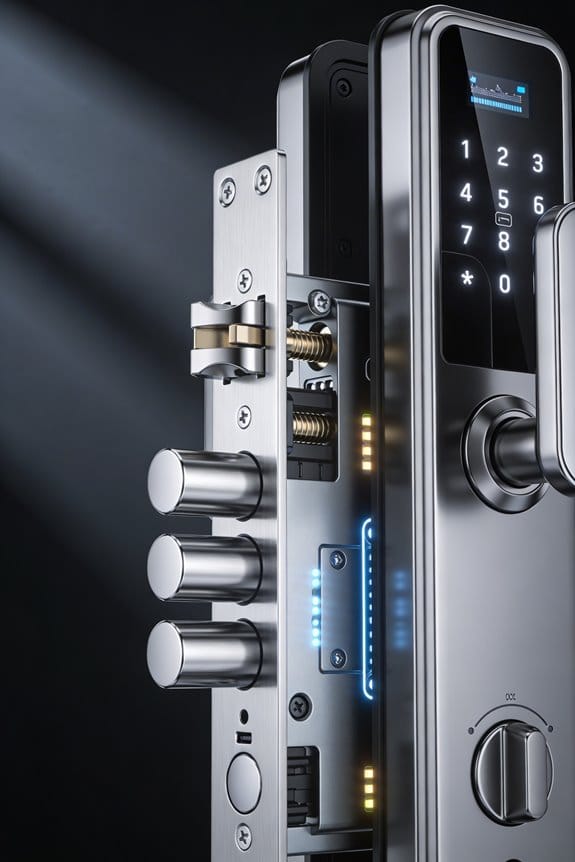
IP68 vs. IP67 vs. IP69K: Which One Protects Best?
Picking the wrong waterproof rating for your smart deadbolt can mean water damage and a broken lock when you need it most. So what’s actually the difference between these three ratings, and which one fits your situation?
Let me break it down. IP67 handles submersion up to 0.5–1 meter for about 30 minutes—think of it as splash-proof with some dunking tolerance. IP68 goes further and lets you submerge the device continuously, as long as you check what depth the manufacturer says is safe. IP69K? That’s different entirely. It’s built for high-pressure water jets hitting at 1450 psi, which makes it perfect for industrial wash-downs but actually terrible for underwater use.
Here’s something people get wrong: all three ratings—IP67, IP68, and IP69K—give you the exact same dust protection (level 6). So you’re not trading dust safety for water safety with any of these.
Why does this matter? Your deadbolt’s location determines which rating you actually need.
For outdoor deadbolts facing rain and splashes, IP68 is your best bet. It’ll handle the weather your porch throws at it without breaking a sweat. But I’ll be honest—plenty of people assume IP68 means “waterproof forever at any depth.” That’s not how it works. You’ve got to read what the manufacturer says about maximum depth and conditions. Don’t just guess.
IP69K is niche. It’s really only for industrial settings where equipment gets blasted with high-pressure washers. Unless you’re installing a lock at a car wash or factory, skip this one.
The takeaway: match the rating to your real-world environment, not to which number sounds strongest. What’s your deadbolt actually going to face—heavy rain, occasional splashes, or something more extreme?
Recommended Products

Palm Vein Unlocking: Advanced Security with 99.9% Accuracy. Achieve recognition in just 0.6 seconds with cutting-edge, forgery-proof palm vein recognition. This next-gen security feature relies on the unique vein patterns in your palm, ensuring top-tier protection. Plus, your palm vein data is stored securely on the device, keeping your privacy intact.

ANYWHERE ACCESS: With built-in WiFi compatibility, you can easily and securely connect your Schlage Encode Deadbolt to your home WiFi network to control and monitor your home from anywhere with the Schlage Home app

EASY CHECK-INS: Share unique door codes through the Yale Access app or compatible partner apps to allow your guests a hands-free check-in process.
Why 30-Minute Tests Don’t Predict Years of Submersion
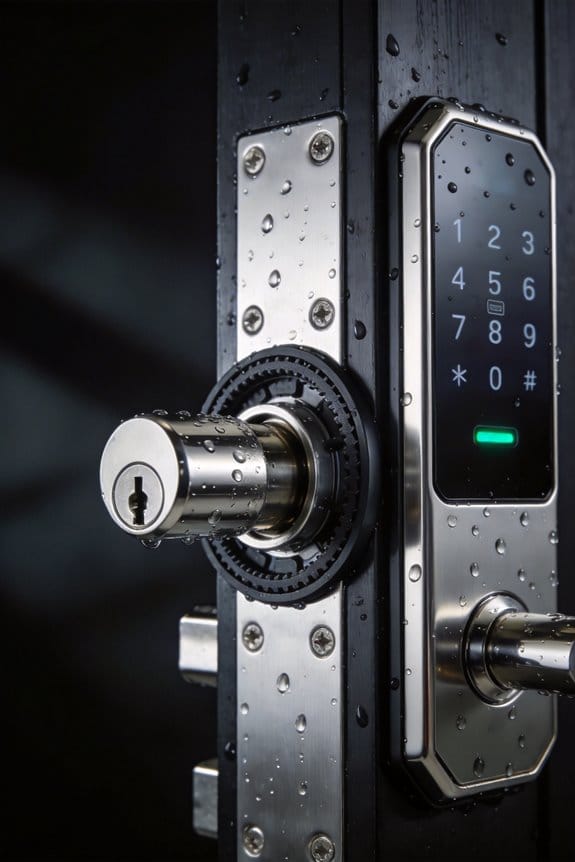
Why 30-Minute Tests Don’t Predict Years of Submersion
You bought a smart deadbolt advertised as waterproof, installed it on your outdoor gate, and felt pretty confident about it. Then six months later, it starts acting up. What happened? Turns out, that IEC 60529 standard‘s 30-minute dunking test—the one manufacturers love to mention—only tells you how a lock behaves in a lab. It says almost nothing about what happens when water, sun, and temperature swings beat on it month after month.
Real-world testing shows something labs can’t replicate: seals slowly break down over time. Thermal cycling (hot days, cold nights) flexes the materials. UV rays degrade rubber and plastics. Salt air corrodes metal parts. Freeze-thaw cycles crack seals from the inside out. Your freshwater test in a controlled room? It doesn’t account for any of that.
So, why does this matter? Because the device that passes the baseline test might be toast within half a year outdoors.
The difference comes down to a few key factors:
- Seal material: Cheap rubber degrades fast. Quality elastomers last longer.
- Installation quality: A poorly installed seal leaves gaps where water sneaks in.
- Your local environment: Saltwater, extreme cold, intense sun—each stresses seals differently.
Frankly, if a manufacturer only mentions the standard 30-minute test on their marketing page, that’s a red flag. The good ones dig deeper. They run extended environmental testing—simulating years of sun, salt, and freeze cycles—and they put those results in the technical specs, even if the flashy product page doesn’t mention it.
Before you buy, ask the manufacturer directly: “Have you tested this beyond the minimum IEC standard?” If they have solid answers with actual data, you’re probably looking at something built to last. If they dodge the question, you might be buying a lock that’ll let you down when you need it most.
Why Dynamic Water Pressure Defeats Static IP68 Protection
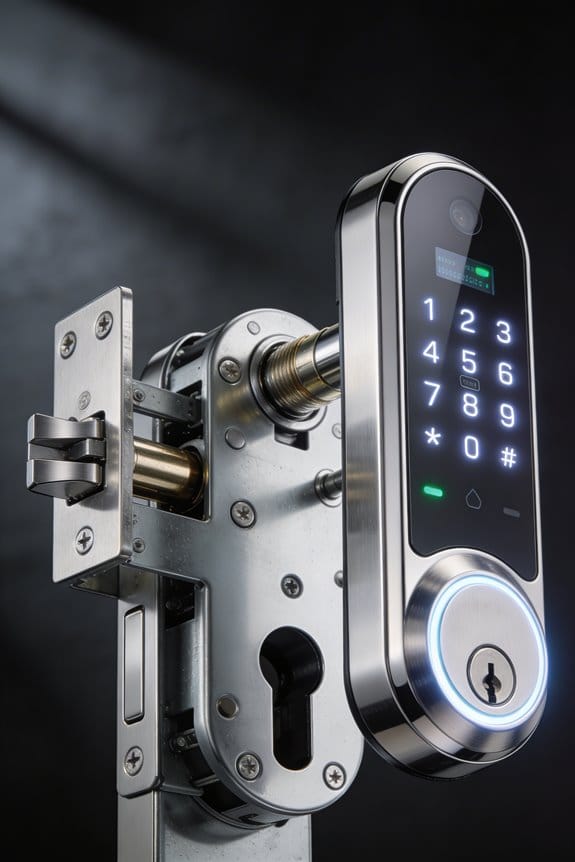
You just bought a smart deadbolt with an IP68 rating—impressive specs that say it survived 30 minutes underwater. But here’s the thing that keeps me up at night: that test doesn’t match what actually happens to your lock outside.
Real outdoor locks don’t sit in still water. They face rain hammering against them, sprinkler spray hitting from weird angles, and waves or jet spray that move constantly across the seals. Static submersion tests miss this entirely. Water that’s moving? It finds microscopic imperfections in your gaskets and forces its way past them under continuous pressure. That’s exactly what dynamic pressure does—it exploits weaknesses that stationary water never would.
Think about it: rain doesn’t gently rest on your lock. It drums against the face with directional force, pushing water laterally across the seal’s surface. A gasket designed to protect against still water pressure crumbles under this kind of assault. I’ve seen locks fail spectacularly in conditions manufacturers swore were covered.
Here’s the real problem—most spec sheets don’t even mention dynamic pressure resistance. They focus on static submersion because that’s what’s easy to test in a lab. But you’re installing this outside, where it faces constant moisture movement and weather exposure that nobody bothered to evaluate.
Saltwater and Chlorine: Materials Beyond the IP68 Standard
Saltwater and Chlorine: Materials Beyond the IP68 Standard
Got a smart deadbolt you’re thinking about installing near the ocean or by a pool? Yeah, that IP68 rating on the box? It’s tested with fresh water, not the salty or chlorinated stuff you’re actually dealing with. That’s a big difference.
Here’s why it matters: saltwater eats through metal fast. We’re talking 6-12 months before corrosion starts breaking down the seals inside your lock. Chlorine does something different—it destroys the rubber gaskets and protective coatings that keep water out. Both environments trash your deadbolt way faster than normal conditions would.
So, why does this matter? Because a broken smart lock near your pool or beach house means you’re either locked out or forking over cash for a replacement sooner than expected.
Manufacturers who actually build for these tough spots use marine-grade stainless steel (the 316L kind), special coatings that resist chemicals, and high-quality rubber gaskets made from EPDM or FKM. The cost difference? Usually $150-400 more per unit. That sounds like a lot, but you’re getting 3-5 years of actual performance instead of watching your investment fail.
Before you buy, here’s the trick: ask the manufacturer directly if their deadbolt handles saltwater or chlorine. Don’t assume. A standard IP68 label just isn’t enough for these environments.
The takeaway? If you’re near salt water or a pool, skip the standard smart deadbolts and spend the extra money upfront. What matters more to you—saving a few bucks now or knowing your lock will actually work when you need it?
Recommended Products


Apple Home Support: Unlock your door with the Apple Home app using your iPhone or Apple Watch. Share access with family and guests. Add a HomePod or Apple TV as a home hub to enable automations and control and share your lock remotely.

Mechanical, keyless push-button lock
When Seals Fail: Expected Lifespan and Maintenance Windows
Your smart deadbolt is sitting on your door right now, keeping your home secure—but those seals? They’re silently deteriorating whether you notice it or not.
Here’s the reality: even if you dropped money on marine-grade materials and premium coatings, those seals aren’t permanent. Most elastomer seals break down in 3–5 years when they’re constantly exposed to the outdoors. If you spring for quality silicone compounds, you might stretch that to 7–10 years. Temperature swings, sun damage, and moisture cycles will wear them down anyway, IP68 rating or not.
But frankly, you’re not stuck replacing your whole lock. A little preventive care keeps seals healthy way longer than you’d think.
What actually works:
Check your seals every three months—look for cracks, discoloration, or spots where the rubber feels hard and brittle. Once a year, apply protective grease to the spots where the seal meets the lock body. These two steps alone make a huge difference.
When a seal finally goes bad, don’t wait until you’re fumbling with your keys in the rain. Replacement kits run $15–40 and take about 15 minutes to install yourself. Think of it like changing your car’s air filter—small maintenance task, big payoff.
So why does this matter? A failed seal means water gets inside, and water inside means a dead battery or corroded electronics at the worst possible moment.
Truth is, seal longevity comes down to whether you stick with a maintenance schedule or ignore it. Stay consistent with inspections and greasing, and your lock’s waterproof protection stays solid.
Recommended Products

𝐒𝐦𝐚𝐫𝐭 𝐋𝐨𝐜𝐤 𝐰𝐢𝐭𝐡 𝐇𝐚𝐧𝐝𝐥𝐞 𝐈𝐧𝐭𝐞𝐠𝐫𝐚𝐭𝐢𝐨𝐧:Combines 2K HD camera, doorbell kit, Bluetooth, Built-in WiFi for app remote control, two-way audio, fingerprint ID, PIR Motion Detection, Auto & One-Touch Lock, rechargeable batteries, IC Card, physical keys and double handles for traditional access.

DIGITAL DOOR LOCKS - install in minutes with pre-drilled holes in the door, all you need is a Philips screwdriver!.Note: Measure your door's backset, cross bore and thickness to ensure you find the right fit.
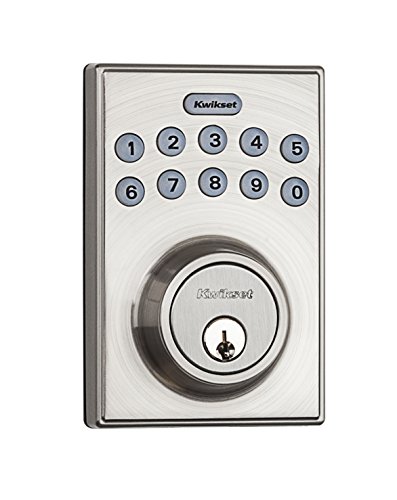
Keyless entry with a motorized driven deadbolt for 1-touch locking, low battery indication, and easy install with just a screwdriver.Control Method:Application.Note: Measure your door's backset, cross bore and thickness to ensure you find the right fit.
How to Verify IP68 Submersion Depth Before Installation
So you’re about to install a smart deadbolt and want to make sure it won’t die the first time it rains hard? Smart move. A lot of people skip this step and regret it later. The thing is, just because something has an IP68 rating doesn’t mean it can survive the exact conditions in your area—that rating only guarantees a bare minimum of 1 meter of submersion according to IEC 60529 standards. What actually matters is digging into the specs for *your* specific model.
Start by hunting down the product datasheet. This is where the real details live. You’re looking for the tested submersion depth—most consumer smart locks fall somewhere between 1.5 and 6 meters. This number tells you how deep underwater your lock can go and still work. Write it down. Seriously.
Next, grab the installation manual and flip to the environmental specifications section. Why does this matter? Because you need to match what the manufacturer tested against what your home actually faces. Are you in a flood-prone area? Do you get monsoon-level rainfall? Does your front door take direct water spray from a hose or sprinkler system? Your lock’s rated depth should comfortably exceed whatever conditions you’re dealing with.
Here’s the trick: pay attention to *how* the manufacturer tested it. There’s a big difference between freshwater testing and saltwater testing. If you’re near the coast or in a salty climate, that detail can mean years of difference in how long your lock lasts. Also note the test duration—how long did the lock stay submerged? A lock that survives 30 minutes underwater might act differently after 24 hours.
Document everything: the exact depth rating, how long it was tested, and whether they used freshwater or saltwater. You don’t need a spreadsheet, just a note on your phone. This way, if something goes wrong down the line, you’ll know exactly what your lock was rated for and whether the failure was a fluke or a sign the product wasn’t right for your situation in the first place.
Does your current setup match up with what the manufacturer tested? If not, you might want to reconsider before installation.
Recommended Products
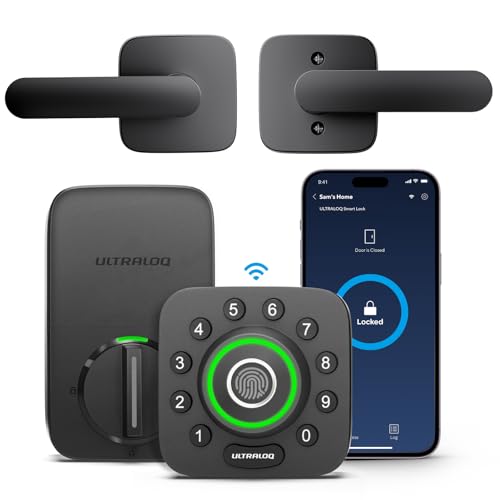
Control Your Ultraloq Smart Lock Anytime, Anywhere: Lock, unlock, share access and see a Log of who’s entered and exactly when they did remotely using smartphone App with built-in WiFi. Connect directly with your home wifi, no extra hub required. Connectivity: 2.4GHz WiFi only
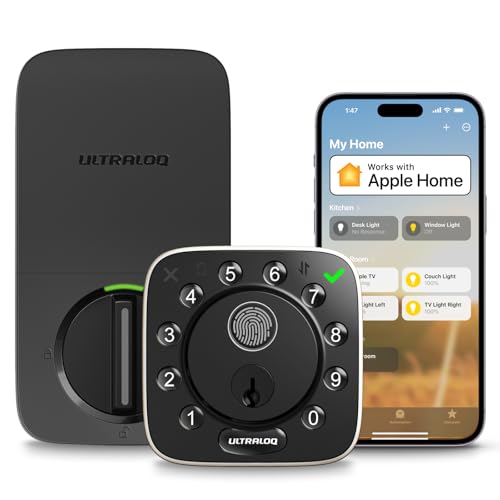
【Apple Home Support】ULTRALOQ’s first fingerprint smart deadbolt is fully integrated with Apple Home. Unlock your door using your iPhone or Apple Watch, share access with family and guests. Add a HomePod or Apple TV as a home hub to enable automations, remote access and control your lock remotely with Siri—making your home smarter, safer, and more connected.
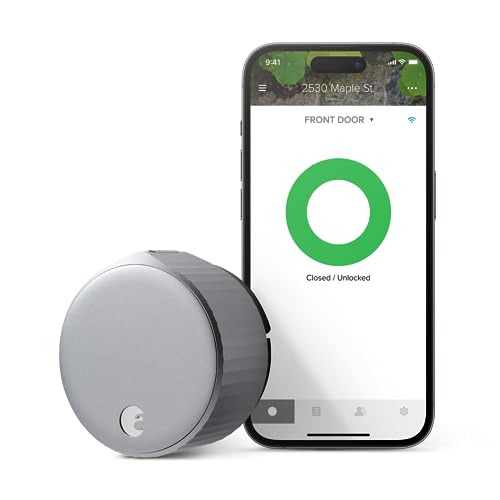
UPGRADE YOUR EXISTING DEADBOLT: August smart locks fit on the inside of your door, making your regular deadbolt smarter, more secure and way more convenient. Keep your keys just in case (but you won’t need them).
Frequently Asked Questions
Can Ip68-Rated Smart Deadbolts Handle Permanent Underwater Installation in Pools or Fountains?
I’d advise against it. While IP68 ratings offer dust protection, water protection, and submersion capability, they’re not designed for permanent underwater installation. Installation limitations exist because manufacturers don’t specify indefinite underwater durability for pool or fountain environments.
Does IP68 Rating Cover Protection Against High-Pressure Water Jets From Pressure Washers?
No, I can’t recommend using an IP68-rated smart deadbolt against pressure washer jets. The rating covers submersion, not pressure washer impact. For high-pressure water jet resistance, you’ll want an IP69K rating instead, which specifically handles forceful spray applications.
How Do Temperature Fluctuations Affect IP68 Seal Integrity Over Multiple Seasons?
I’d tell you that temperature effects from seasonal changes can degrade your IP68 seal’s integrity over time. Thermal expansion and contraction stress the sealing materials, potentially creating micro-gaps that compromise water resistance as years pass.
Are IP68 Smart Locks Safe for Coastal Properties Exposed to Salt Spray Constantly?
I’d caution you here: standard IP68 ratings don’t guarantee protection against coastal corrosion from saltwater exposure. You’ll need locks specifically engineered with specialized coatings or marine-grade materials to safely handle constant salt spray at your coastal property.
What Maintenance Intervals Restore IP68 Protection After Seal Degradation Begins Occurring?
I’d recommend checking your manufacturer’s guidelines, as they specify seal maintenance intervals for your particular model. You’ll typically need annual inspections and resealing every 2-3 years to restore IP68 protection effectively as degradation occurs.